
Top 10 Fashion Essentials Every Modern Wardrobe Needs
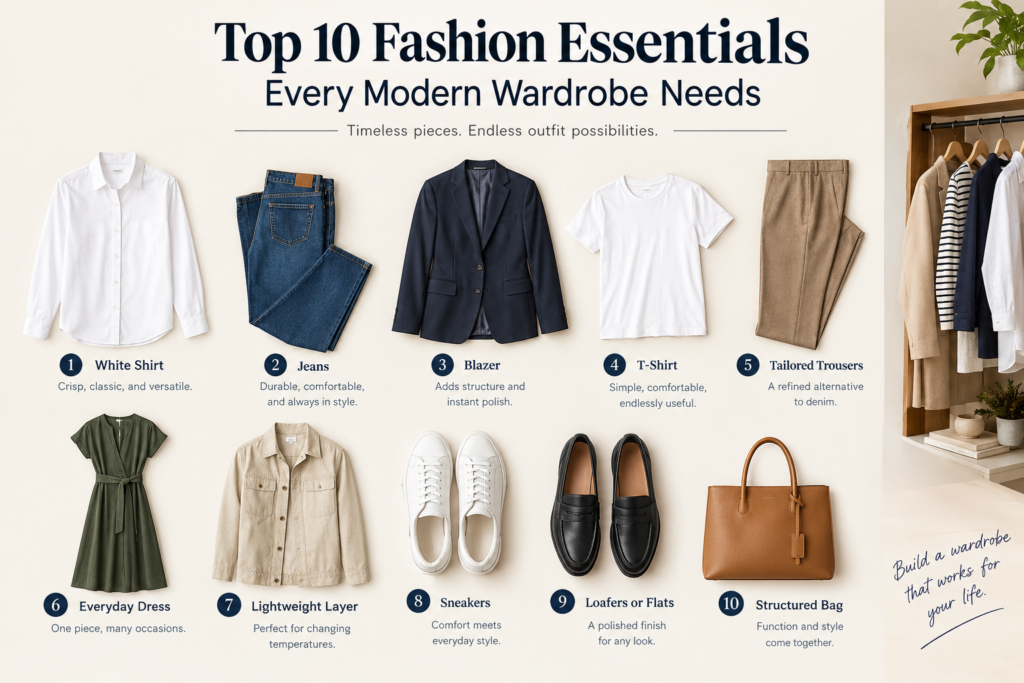
A modern wardrobe does not need to be enormous to be versatile. It needs the right pieces: clothing that fits well, works across different occasions, complements existing outfits, and remains useful beyond a single season. A carefully chosen white shirt can work for the office, a weekend lunch, or an evening out. A well-fitting pair of jeans can serve as the foundation for dozens of different looks.
The idea behind a functional wardrobe is simple: buy fewer pieces that work harder, rather than filling your closet with items that rarely get worn.
The most useful fashion essentials are not necessarily expensive, designer-branded, or dictated by the latest runway trend. They are dependable staples that reflect your lifestyle, personal taste, climate, and budget. Some provide structure, others offer comfort, and a few serve as versatile finishing touches that make an outfit feel complete.
This Top 10 list focuses on the core clothing and footwear categories that help build a practical, adaptable wardrobe. Each selection earns its place through versatility, styling potential, and everyday usefulness—not because every person must own exactly the same items.
1. The Classic White Shirt: The Most Versatile Wardrobe Foundation

A well-cut white button-down shirt is one of the most adaptable pieces in a modern wardrobe. It offers a balance of polish and simplicity, making it appropriate for professional settings, casual outings, and more formal occasions when styled thoughtfully.
Why it deserves a place: A white shirt creates a clean foundation for almost any outfit. Wear it tucked into tailored trousers for work, with blue jeans for a relaxed weekend look, or open over a fitted top as a lightweight outer layer.
The material and cut determine how useful it becomes. Cotton poplin has a crisp, structured finish, while Oxford cloth offers a slightly more textured, casual appearance. Linen and linen-cotton blends are worth considering in hot, humid climates because they generally allow more airflow than heavier fabrics.
What to look for:
- A collar that sits comfortably without gaping.
- Enough room across the shoulders and chest for natural movement.
- Fabric that is not excessively transparent for your intended use.
- A length that works both tucked in and worn loose, if you want maximum versatility.
The main drawback is maintenance. White fabric can show stains easily, and some cotton shirts wrinkle after washing.
Best for: Office workers, students, professionals, and anyone who wants one shirt that can move between smart and casual outfits.
Styling tip: Combine a white shirt with dark denim, a brown or black belt, and loafers for an outfit that feels considered without looking overdressed.
2. Well-Fitting Jeans: Everyday Style With Lasting Appeal

Jeans remain a dependable wardrobe staple because they combine durability, comfort, and styling flexibility. However, the right pair is less about following a particular denim trend and more about finding a cut that suits your proportions and daily activities.
Straight-leg jeans are a strong starting point because they generally work with T-shirts, button-down shirts, sweaters, sneakers, and boots. Slim, wide-leg, relaxed, and tapered cuts offer different silhouettes, so there is no single fit that works best for everyone.
Dark indigo denim tends to create a more polished appearance, while lighter washes feel more casual. Black jeans can be useful for evening outfits or wardrobes built around monochromatic colors.
Before buying, consider the fabric composition. Rigid denim offers a traditional feel and may soften with wear, while denim containing elastane usually provides more stretch. Excessive stretching or repeated high-heat drying can affect the fit of some jeans.
Advantages:
- Easy to combine with casual and smart-casual clothing.
- Suitable for regular wear when the fit and fabric match the activity.
- Available in a wide range of cuts, rises, washes, and price points.
Limitations: Jeans may feel too warm in humid weather, and many workplaces do not consider denim appropriate business attire.
Best for: Everyday wear, travel, casual offices, and weekend activities.
Styling tip: Choose a wash that complements the trousers, shoes, and tops you already own. One dependable pair that fits well is often more useful than several pairs that rarely leave the closet.
3. A Neutral Blazer: An Easy Way to Look More Polished

A blazer adds structure to an outfit without requiring a complete change of clothing. It is particularly useful when you need to move from a casual setting to a professional or semi-formal one.
Navy, black, charcoal, and muted brown are versatile starting colors. A single-breasted blazer with a moderate shoulder structure is often easier to style across different occasions than a highly embellished or strongly trend-driven design.
The distinction between a blazer and a suit jacket matters. A suit jacket is designed to coordinate with matching trousers or a skirt, whereas a standalone blazer is generally intended to work with separate pieces.
For everyday versatility, look for a blazer that allows comfortable movement when buttoned and worn open. Lightweight cotton blends, linen blends, and unlined constructions can be useful in warmer climates. Wool and wool blends may offer better structure for cooler environments, depending on their weight and construction.
What makes it useful: A blazer can make a plain T-shirt and jeans look more intentional, give tailored trousers a professional finish, or add definition to a simple dress.
Its main limitation is comfort in high heat. Heavy lining, thick padding, and restrictive cuts may make a blazer impractical for everyday outdoor wear in tropical weather.
Best for: Interviews, office meetings, presentations, dinners, and occasions requiring smart-casual clothing.
Styling tip: For a relaxed outfit, wear a lightweight navy blazer over a neutral T-shirt with straight-leg jeans. For a formal setting, coordinate it with tailored trousers and clean, understated footwear.
4. The Plain T-Shirt: A Reliable Base for Everyday Outfits

A plain T-shirt may be one of the simplest items in a wardrobe, but that simplicity is precisely what makes it useful. It can be worn alone, layered beneath a shirt or jacket, or paired with more formal pieces to create a relaxed contrast.
White, black, grey, navy, and muted earth tones are practical choices because they coordinate easily with denim, chinos, skirts, and shorts.
Fabric deserves more attention than branding. Cotton jersey is a common option because it is soft and comfortable for everyday wear. Cotton blends can improve stretch, shape retention, or wrinkle resistance, depending on the fibers and construction.
A heavier T-shirt often holds a more structured silhouette, while lightweight jersey can feel more comfortable in hot weather. Neither is automatically superior; the best choice depends on how you intend to wear it.
Check before buying:
- The neckline retains its shape.
- The shoulder seams sit where you want them.
- The fabric is comfortable against your skin.
- The shirt maintains suitable coverage when worn or tucked in.
- The care instructions fit your routine.
The biggest limitation of a basic tee is that it may look too casual for formal environments. A faded, stretched, or poorly fitting T-shirt can also weaken an otherwise polished outfit.
Best for: Daily wear, layering, travel, casual work environments, and weekend styling.
Styling tip: Pair a clean white T-shirt with dark trousers and loafers for a simple smart-casual look, or wear it with jeans and sneakers for everyday comfort.
5. Tailored Trousers: The Smarter Alternative to Everyday Denim

Tailored trousers provide a more refined alternative to jeans while remaining versatile enough for regular use. They are especially valuable for people whose wardrobes need to accommodate office days, professional meetings, dinners, and other occasions where denim feels too informal.
Black, charcoal, navy, and brown are dependable colors. Straight-leg and relaxed-leg cuts can work particularly well because they offer room for movement without relying on an extremely fitted silhouette.
Fabric choice determines both appearance and comfort. Lightweight wool blends can create a structured, professional finish, while cotton twill and breathable blended fabrics may suit everyday wear. Linen blends can be comfortable in warm weather but may crease more readily.
Fit is crucial. The waistband should sit comfortably, the fabric should fall cleanly through the hips and legs, and the hem should work with your intended footwear. Small alterations to trouser length can make a noticeable difference.
Advantages:
- More formal than most jeans.
- Easy to pair with shirts, blouses, knitwear, and blazers.
- Suitable for both professional and selected social occasions.
Limitations: Certain fabrics require pressing or careful laundering, and highly formal cuts may feel out of place in relaxed settings.
Best for: Office wear, business-casual environments, interviews, presentations, and dressier everyday outfits.
Styling tip: Combine charcoal trousers with a white shirt and black loafers for a clean professional look. On less formal days, swap the shirt for a plain T-shirt and lightweight sneakers.
6. A Versatile Everyday Dress: One Piece, Multiple Occasions

For anyone who enjoys dresses, a versatile day dress can simplify outfit planning because the main clothing combination is already complete. The right design can move between daytime activities, casual gatherings, and selected evening occasions with a change of footwear or accessories.
A shirt dress, simple midi dress, wrap-style dress, or understated A-line silhouette can be a practical choice. The ideal option depends on personal preference, comfort, coverage requirements, and the occasions for which you dress most often.
Fabric selection is particularly important. Cotton poplin can create a crisp shape, viscose or other drapey fabrics can produce a softer silhouette, and linen blends are useful for relaxed warm-weather dressing. Always check the care instructions and whether the fabric needs a lining.
What to consider:
- Whether the dress allows comfortable sitting, walking, and reaching.
- Whether its neckline and hem suit your preferences.
- Whether it can be layered with a cardigan, shirt, or blazer.
- Whether it works with shoes you already own.
A dress is not automatically a universal solution. Some designs are too formal for daily wear, while others offer little flexibility in colder weather or for activities requiring separate tops and bottoms.
Best for: Social gatherings, casual offices, daytime events, holidays, and occasions when a coordinated outfit is useful.
Styling tip: Wear a simple midi dress with flat sandals during the day, then add a blazer, understated jewelry, and dressier shoes for an evening event.
7. A Lightweight Layer: The Practical Alternative to Heavy Outerwear
Not every wardrobe needs a heavy coat. For people living in warmer climates or experiencing mild seasonal changes, a lightweight jacket, overshirt, or cardigan can provide more everyday value.
An overshirt sits between a traditional shirt and a jacket. It usually has a slightly roomier cut, allowing it to be worn over a T-shirt or lightweight top. A cardigan offers a softer, more flexible layer, while a denim jacket adds a casual, structured finish.
Choose the style according to your daily environment. Cotton twill and lightweight denim provide structure, while fine-gauge cotton knits offer a softer alternative. A water-resistant shell may be more useful than a fashion jacket during rainy commutes.
Why it earns a place: A versatile layer adds visual depth, helps accommodate changing temperatures, and gives familiar outfits a different appearance without requiring new trousers or tops.
Its limitations depend on the design. A thick denim jacket may be uncomfortable in humid weather, while an unlined overshirt provides little protection against heavy rain or cold winds.
Best for: Commuters, travelers, students, and anyone who needs flexible layering rather than substantial winter clothing.
Styling tip: Wear an olive or beige overshirt over a white T-shirt with dark jeans. The combination creates contrast while keeping the overall outfit simple.
8. Comfortable Sneakers: Everyday Footwear That Works Hard

A versatile pair of sneakers can be one of the most frequently worn items in a modern wardrobe. They work with jeans, casual trousers, T-shirts, dresses, and many contemporary smart-casual outfits.
Low-profile sneakers in white, cream, grey, or black are particularly easy to coordinate. Leather and synthetic-leather styles often create a cleaner, more structured appearance, while mesh and textile uppers may offer greater ventilation.
Appearance, however, should not be the only selection criterion. A stylish sneaker that causes discomfort after a short walk is unlikely to become a reliable everyday essential.
What to check before buying:
- Adequate toe room and a secure heel fit.
- Cushioning appropriate for your daily walking.
- A sole that provides suitable grip for your usual surfaces.
- Materials that are practical for your climate and maintenance preferences.
Not all fashion sneakers are designed for running, sports, or extended periods of physical activity. Dedicated athletic footwear may be more suitable when performance, support, or sport-specific features matter.
White sneakers also require regular cleaning, especially in rainy or muddy conditions. Darker colors may be easier to maintain for frequent outdoor use.
Best for: Everyday commuting, travel, casual outings, and relaxed smart-casual dressing.
Styling tip: Pair clean sneakers with tailored trousers and a button-down shirt for a contemporary look that balances comfort with structure.
9. Loafers or Simple Flats: A Polished Alternative to Sneakers

Sneakers cover casual occasions well, but some situations call for a more refined shoe. Loafers, ballet flats, and other simple flat styles fill that gap without requiring high heels.
Loafers typically feature a slip-on design with a structured upper, making them suitable for many office and smart-casual settings. Ballet flats offer a lighter, often more delicate silhouette, while structured leather flats can provide a more formal appearance.
Black and brown are versatile starting colors, although burgundy, tan, and other muted shades can add personality without making coordination difficult.
Materials and construction influence comfort and longevity. Leather may soften and adapt with wear, but it can require more maintenance than some synthetic alternatives. Textile and synthetic uppers offer different price and care options. The quality of the sole, seams, and internal cushioning also matters.
Advantages:
- A polished alternative to casual sneakers.
- Easy to coordinate with dresses, skirts, jeans, and tailored trousers.
- Useful for workplaces and social settings that call for understated footwear.
Limitations: Some loafers need a break-in period, and thin-soled flats may offer insufficient cushioning for extensive walking. Fit and construction matter more than the category name.
Best for: Office wear, dinners, presentations, semi-formal gatherings, and everyday outfits that need a smarter finish.
Styling tip: Combine black loafers with straight-leg trousers and a white shirt. For a more relaxed look, wear them with dark denim and a simple knit top.
10. A Structured Everyday Bag: Function Meets Personal Style

A practical everyday bag completes a wardrobe by carrying the items you need while contributing to the overall appearance of an outfit. Unlike clothing basics, a bag also needs to perform a functional job, so its size, construction, and organization deserve as much attention as its design.
A medium-sized tote works well for people who carry documents, a water bottle, or other daily necessities. A crossbody bag offers hands-free convenience, while a compact shoulder bag may be better for lighter loads and social occasions.
Black, brown, tan, and other neutral shades are generally easy to coordinate. However, a colorful bag can also become a signature accessory if it complements your usual clothing palette.
Look for durable stitching, secure closures, comfortable straps, and an interior that suits your belongings. If you regularly carry a laptop, check the dimensions and padding rather than assuming a bag will protect electronic equipment.
Material choice involves trade-offs. Leather can develop a distinctive appearance with use but may require conditioning and protection from moisture. Canvas and synthetic materials can be lighter or easier to maintain, depending on their construction.
Best for: Professionals, students, commuters, travelers, and anyone who needs a dependable daily carry option.
Styling tip: A structured tan or black bag can complement jeans, tailored trousers, dresses, and neutral layers. Choose one based on what you carry rather than buying a bag solely because it looks good in photographs.
Quick Comparison: Which Fashion Essentials Should You Prioritize?
The most useful starting point depends on your lifestyle, climate, and the clothes you already own.
| Essential | Best use | Main advantage | Key consideration |
|---|---|---|---|
| White shirt | Work and casual occasions | Highly adaptable | Wrinkles and stains |
| Jeans | Everyday wear | Durable, easy to style | Fit and warm-weather comfort |
| Neutral blazer | Professional and smart-casual outfits | Adds structure | Heat and fit |
| Plain T-shirt | Daily wear and layering | Simple and comfortable | Fabric weight and shape retention |
| Tailored trousers | Work and formal-casual settings | Polished appearance | Fabric care and alterations |
| Everyday dress | Social and daytime occasions | A complete outfit in one piece | Versatility and coverage |
| Lightweight layer | Commuting and changing temperatures | Flexible layering | Limited weather protection |
| Sneakers | Casual wear and walking | Everyday practicality | Support and cleaning |
| Loafers or flats | Smart-casual occasions | More refined than sneakers | Fit and cushioning |
| Structured bag | Work, travel, and daily errands | Combines utility with style | Capacity and construction |
The comparison is a practical starting point rather than a universal ranking. A person who works remotely may need fewer formal pieces, while someone who attends frequent meetings may prioritize a blazer and tailored trousers.
How to Choose the Right Fashion Essentials for Your Wardrobe
Buying wardrobe staples is most effective when you start with your actual routine rather than an idealized image of how you want to dress.
1. Start with your weekly activities
Consider what you wear to work, study, commute, exercise, attend social events, and relax at home. Your essential pieces should support those activities.
If most of your week involves walking and casual outings, comfortable sneakers and well-fitting trousers may deliver more value than formal shoes. If you work in a business-casual office, a blazer and tailored trousers may be more useful.
2. Choose fabrics for your climate
Fabric affects comfort, appearance, maintenance, and how often you will reach for an item.
- Cotton: A versatile option for T-shirts, shirts, and casual trousers.
- Linen: Often useful in hot weather because of its breathable structure, although it wrinkles readily.
- Cotton blends: Can balance comfort with easier care or added stretch.
- Wool blends: Useful for structured trousers and blazers, particularly in cooler conditions or climate-controlled environments.
- Synthetic fabrics: May offer wrinkle resistance, durability, or stretch, depending on fiber and construction.
No single fiber is ideal for every garment. Fabric weight, weave, lining, and fit all affect the finished result.
3. Build a coordinated color palette
Start with two or three colors that work well together, such as navy, white, and beige, or black, grey, and cream. Add colors or patterns that reflect your personality.
A coordinated palette makes it easier to combine shirts, trousers, footwear, and outer layers without buying matching sets.
4. Prioritize fit over labels
A moderately priced garment that fits comfortably and suits your proportions may be more useful than an expensive item that stays in the closet.
Check shoulder placement, sleeve length, waistband comfort, trouser hems, and freedom of movement. Consider simple alterations when the garment is otherwise well made.
5. Evaluate cost per wear
Cost per wear is the purchase price divided by the number of times you wear an item.
For example, a shirt costing $40 that you wear 80 times has a cost per wear of $0.50. A $100 shirt worn 20 times has a cost per wear of $5.
These figures are illustrative, not predictions of garment lifespan. They demonstrate why usefulness and frequency of wear matter alongside the initial price.
6. Consider maintenance and longevity
Check care labels before buying. Some garments require delicate washing, ironing, special storage, or professional cleaning. If your routine makes those requirements inconvenient, a lower-maintenance alternative may be the better choice.
Repairing loose seams, cleaning footwear, and storing clothing properly can also help extend useful life.
7. Buy in stages
You do not need to purchase all ten items at once. Identify the gaps in your existing wardrobe, replace worn-out essentials first, and add pieces only when they solve a genuine need.
This measured approach is consistent with capsule-wardrobe guidance from EarthDay.org and fashion editors who emphasize versatility and thoughtful selection rather than simply accumulating more clothes.
Frequently Asked Questions
1. What are the ten essential items for a modern wardrobe?
Ten useful categories are a white shirt, well-fitting jeans, a neutral blazer, a plain T-shirt, tailored trousers, a versatile dress, a lightweight layer, comfortable sneakers, loafers or flats, and a structured everyday bag. The exact selection should reflect your lifestyle, personal preferences, and climate.
2. How many clothes do you need for a functional wardrobe?
There is no universally correct number. A functional wardrobe can be relatively small if its pieces coordinate well and cover your regular activities. Focus on creating enough combinations for your week rather than meeting a fixed clothing count.
3. Which colors are best for building a versatile wardrobe?
Black, white, navy, grey, beige, and brown are common starting points because they coordinate easily. However, the best palette is one that complements your existing clothes and reflects your taste. A few accent colors can make basic outfits more distinctive.
4. Are expensive clothes better than affordable alternatives?
Not necessarily. Price alone does not establish quality, comfort, or durability. Examine fabric, stitching, fit, construction, care requirements, and how frequently you expect to wear the garment before deciding how much to spend.
5. What fabrics are best for everyday clothing in hot weather?
Lightweight cotton, linen, and suitable blends are common choices for warm climates. Breathability also depends on the fabric’s weave, weight, and garment construction. Loose-fitting designs may feel more comfortable than tight, heavily lined clothing in humid conditions.
6. How can you make basic outfits look more stylish?
Pay attention to fit, proportions, color coordination, and the condition of your clothing. Combining a simple T-shirt with tailored trousers, adding a lightweight layer, or choosing appropriate footwear can change an outfit’s overall impression without requiring a completely new wardrobe.
7. How often should you replace wardrobe essentials?
Replace items when they no longer fit comfortably, meet your needs, or remain in good repair. There is no fixed replacement schedule for every garment. Washing practices, frequency of wear, fabric quality, and storage conditions all influence how long clothing remains usable.
8. What is the difference between wardrobe essentials and a capsule wardrobe?
Wardrobe essentials are individual staple pieces that serve recurring needs. A capsule wardrobe is a coordinated collection of clothing designed to work together across multiple outfits. Essentials can form the foundation of a capsule wardrobe, but a capsule also requires thoughtful choices about quantity, color, and compatibility.
Final Verdict: Build a Wardrobe Around What You Actually Wear
The best fashion essentials are the pieces that earn their place through repeated use. A white shirt provides flexibility, jeans deliver everyday practicality, tailored trousers and a blazer add polish, and comfortable footwear helps make outfits work in real life. A versatile dress, lightweight layer, and dependable bag fill different needs without requiring an oversized closet.
The goal is not to follow a rigid list or dress like everyone else. It is to create a collection of clothing that works together, suits your environment, and reflects your personal style.
Start by reviewing what you already own. Identify the items you wear most often, notice what is missing, and prioritize pieces that complement several existing outfits. With thoughtful choices, even a modest wardrobe can offer variety, comfort, and a consistent sense of style.