
10 Best Sustainable Fashion Trends Changing the Industry
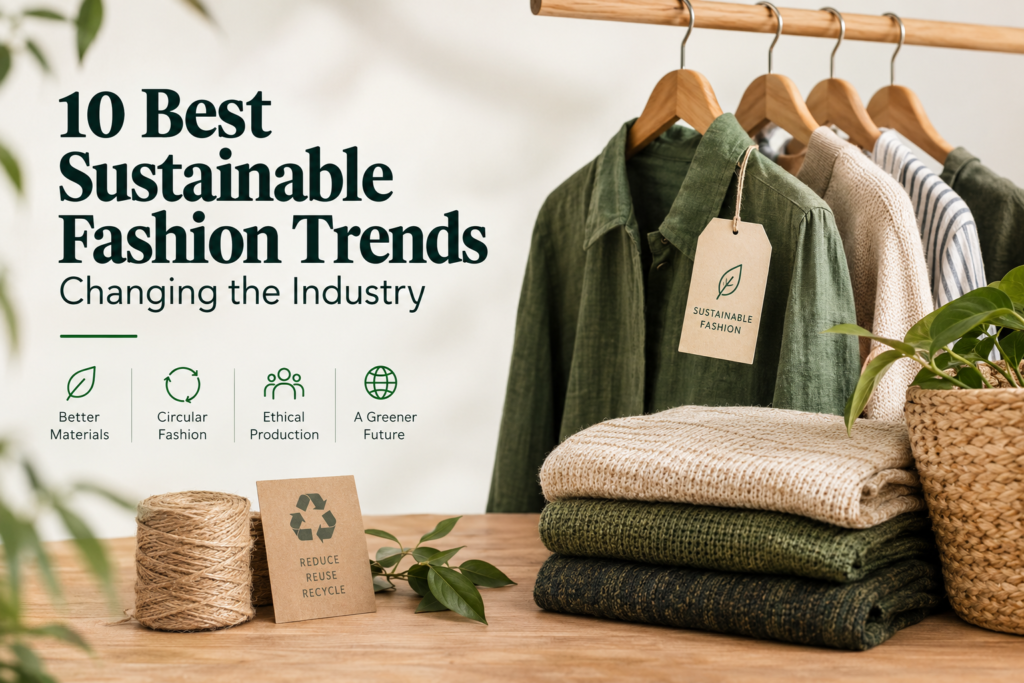
Fashion is beginning to change in a way that goes beyond seasonal colors, new silhouettes, and designer collections. Increasingly, the conversation is about what clothes are made from, how long they last, who makes them, and what happens when people stop wearing them.
The shift matters because conventional fashion often follows a linear model: extract raw materials, manufacture garments, sell them, and eventually discard them. The United Nations Environment Programme (UNEP) identifies overproduction, overconsumption, pollution, and limited reuse and recycling infrastructure as major challenges for the textile industry.
Sustainable fashion offers a different approach. It combines responsible material sourcing, durable design, resource-efficient manufacturing, fairer working conditions, and systems that keep clothing in use for longer. Some developments are already accessible to everyday shoppers, while others require investment in textile technology and supply chains.
This guide explores the 10 best sustainable fashion trends changing the industry, selected for their practical relevance, potential environmental or social benefits, and ability to address different stages of a garment’s life cycle. Rather than treating every innovation as an automatic solution, each entry examines what makes it useful, where it falls short, and what consumers and fashion businesses should consider.
1. Secondhand Fashion and Clothing Resale

Best for: Budget-conscious shoppers, vintage enthusiasts, and anyone looking to extend the useful life of existing clothing.
Secondhand fashion is one of the most accessible ways to participate in sustainable fashion. Instead of purchasing a newly manufactured garment, shoppers buy clothing that someone else has owned, allowing existing materials, labor, and manufacturing resources to deliver value for longer.
Resale happens through thrift shops, vintage boutiques, online marketplaces, consignment stores, and brand-operated resale programs. Common purchases include denim, outerwear, formalwear, handbags, and everyday basics.
The environmental case is strongest when a secondhand purchase replaces a new purchase. Research published by the UK waste-reduction organization WRAP in February 2025 found that three out of five preloved items purchased in its study displaced a new purchase. The actual benefit depends on consumer behavior and the garment’s life cycle.
The Waste and Resources Action Programme
Why this trend stands out
- It gives wearable garments another use cycle.
- It can make higher-quality clothing more affordable.
- It offers access to vintage styles and discontinued designs.
- It creates opportunities for resale businesses and local retailers.
What to watch out for: Not every secondhand garment is a good purchase. Check the fabric condition, seams, zippers, stains, sizing, and seller return policy. Buying more used clothing than you need can still encourage overconsumption.
For fashion brands, resale programs can strengthen customer relationships, but authentication, cleaning, grading, photography, shipping, and returns add operational costs.
The best approach is to prioritize items you will wear regularly rather than treating secondhand shopping as an excuse to expand your wardrobe indefinitely.
2. Organic Cotton and More Responsibly Sourced Natural Fibers

Best for: T-shirts, shirts, underwear, baby clothing, and everyday garments where comfort and material sourcing matter.
Organic cotton is grown according to organic agricultural requirements, which generally prohibit synthetic pesticides and fertilizers used in conventional farming, subject to the applicable standard. It is a prominent example of the broader move toward more responsible fiber production.
Other materials receiving attention include responsibly sourced linen, hemp, and wool. Each has different agricultural requirements, processing needs, durability characteristics, and impacts.
For example, linen is made from flax and is valued for its breathability. Hemp can produce strong fibers, although processing methods and finishing treatments affect its overall footprint. Wool provides insulation and can be durable, but animal welfare, land management, and methane emissions are relevant considerations.
Why this trend stands out
- It encourages greater scrutiny of agricultural inputs and fiber origins.
- Natural fibers can provide comfort and useful performance characteristics.
- Responsible sourcing programs can improve transparency across supply chains.
- It encourages brands to compare materials rather than selecting them on price alone.
Textile Exchange’s Fiber and Materials Matrix provides a framework for assessing material-related initiatives across climate, nature, people, animal welfare, and governance. This reflects a broader industry shift away from judging a fiber by a single environmental attribute.
Textile Exchange
The limitation: Organic does not automatically mean environmentally superior in every respect. Water use, land requirements, dyeing, finishing, transportation, and garment lifespan also matter. Certification claims should be checked against the specific standard and product scope.
For consumers, look for clear fiber-composition labels and credible evidence of sourcing claims. For manufacturers, evaluate the entire material supply chain rather than relying on the words natural or organic alone.
3. Recycled Fabrics and Textile-to-Textile Recycling

Best for: Apparel manufacturers, denim brands, sportswear companies, and shoppers seeking alternatives to virgin materials.
Recycled fabrics are made partly or entirely from materials recovered from existing products or manufacturing waste. Common examples include recycled polyester, recycled nylon, and recycled cotton.
Recycled polyester is frequently produced from plastic bottles or existing polyester textiles. Recycled cotton can come from cutting-room scraps and discarded cotton garments, which are processed into fibers for new textile products.
However, there is a meaningful difference between recycling plastic into clothing and recycling old clothing into new clothing. The former can divert plastic from one waste stream, but it does not necessarily create a circular textile system. Textile-to-textile recycling aims to recover fibers from discarded garments and return them to textile production.
Why this trend stands out
- It can reduce demand for virgin raw materials.
- It creates potential uses for manufacturing offcuts and discarded textiles.
- It supports circular production models.
- It encourages investment in sorting, fiber recovery, and material-processing technologies.
The limitation: Mechanical recycling can shorten fibers, particularly cotton, making it difficult to produce yarn with the same strength or fineness without blending in stronger or virgin fibers. Textile blends, dyes, buttons, zippers, and finishing chemicals can also complicate recycling.
Synthetic fabrics may release microfibers during washing, so recycled content alone does not resolve every environmental concern.
The European Commission reports that only around 1% of material used to produce clothing is recycled into new clothing, illustrating the gap between collecting textile waste and achieving large-scale textile-to-textile recycling.
What to look for: Check the percentage of recycled content and whether it comes from post-consumer textiles, manufacturing waste, or another source. For manufacturers, evaluate fiber quality, blend compatibility, product performance, and the availability of recycling facilities.
4. Timeless Wardrobes and Durable Garment Design

Best for: Minimalists, working professionals, families, and shoppers who want more use from fewer garments.
A capsule wardrobe is a deliberately limited collection of versatile clothing that works together across multiple outfits. The broader trend toward timeless design emphasizes durability, versatility, repairability, and personal style over frequent replacement.
This approach changes the question from “What is fashionable this month?” to “Will I still wear this garment in several years?”
For manufacturers, durable design involves more than choosing thick fabric. It includes appropriate yarn and fabric selection, reinforced stress points, secure seams, reliable fasteners, colorfastness, and construction suited to the intended use.
The Ellen MacArthur Foundation identifies physical durability, emotional durability, and the ability to remake or recycle a product as important elements of circular fashion design.
What makes it useful?
- Versatile pieces can be worn across multiple occasions.
- Better construction can reduce premature garment failure.
- Classic designs may remain desirable longer.
- Fewer unnecessary purchases can reduce spending and wardrobe clutter.
The trade-off: Durable clothing may cost more upfront, and a minimalist wardrobe is not automatically sustainable if its contents are frequently replaced or poorly made. Some specialist clothing also needs regular replacement for safety or performance reasons.
For example, a well-constructed pair of trousers that suits work, travel, and casual outings may provide more value than several inexpensive pairs worn only occasionally.
Before purchasing, consider fit, fabric care, seam quality, repair options, and how many existing garments the item can complement. Cost per wear is a useful comparison:
5. Clothing Rental and Fashion Subscription Services

Best for: Wedding guests, event attendees, occasional formalwear users, and people who need temporary access to specialist clothing.
Clothing rental allows customers to borrow garments for a defined period instead of owning them. Rental businesses commonly focus on occasionwear, designer clothing, maternity garments, and selected premium everyday pieces.
The model can be particularly useful for expensive items that customers wear infrequently. A formal outfit used once for an event is a strong candidate for sharing, provided rental genuinely replaces individual purchases.
Rental companies typically manage garment inventory, booking, cleaning, inspection, repairs, and redistribution. Subscription models may offer customers access to a rotating selection of clothing for a recurring fee.
Advantages
- Reduces the need to purchase outfits for one-off occasions.
- Gives customers access to styles they might not otherwise buy.
- Can increase the utilization of existing garments.
- May reduce storage needs for occasional-use clothing.
Limitations to consider
Rental is not automatically lower-impact than ownership. Transportation, packaging, commercial laundering, dry-cleaning chemicals, and garment wear all affect the outcome. The number of rental cycles a garment completes is especially relevant.
Availability and sizing can also be restrictive, while rental fees, deposits, late charges, and damage policies vary between providers.
For fashion businesses, rental is most promising when garments are durable, cleaning requirements are manageable, and inventory can be circulated efficiently.
Practical tip: Compare the full rental cost, including delivery and cleaning fees, with buying a secondhand garment or borrowing from someone you know. Choose rental when temporary access solves a genuine need rather than simply creating another shopping habit.
6. Upcycled Fashion and Creative Garment Reconstruction

Best for: Independent designers, creative shoppers, small fashion labels, and manufacturers looking to reuse textile waste.
Upcycling transforms existing materials or products into something useful or desirable, often with a new design, function, or appearance. In fashion, this can involve turning discarded denim into jackets, converting fabric offcuts into accessories, or reconstructing surplus garments into limited-edition pieces.
Unlike conventional recycling, which may break materials down into fibers or other feedstocks, upcycling often preserves more of the original fabric’s structure and value.
For example, a garment factory producing large quantities of cotton shirts may generate cutting-room offcuts. A designer could sort these scraps by color and size, then use them for patchwork panels, pocket details, tote bags, or smaller accessories.
Why it deserves a place on this list
- It can reduce waste from cutting and garment production.
- It encourages creative reuse of existing materials.
- It gives designers opportunities to create distinctive products.
- It can support small-batch manufacturing and craft-based businesses.
The limitation: Upcycling can require significant sorting, pattern development, and manual labor. Supply may be inconsistent because reclaimed fabrics vary in color, condition, composition, and quantity.
That makes it harder to scale than manufacturing from standardized rolls of new fabric. A product marketed as upcycled also needs a clear explanation of what material was recovered and how it was used.
For apparel manufacturers, the most practical starting point is often predictable production waste. Clean, segregated offcuts are easier to reuse than mixed waste contaminated with chemicals, finishes, or unrelated materials.
For consumers, look for sound stitching, secure construction, and transparent material descriptions. A creative design is more useful when it is also comfortable, durable, and easy to maintain.
7. Repair, Visible Mending, and Garment Care
Best for: Anyone with wearable clothing that has damaged seams, missing buttons, small holes, or worn areas.
Repair-focused fashion challenges the idea that a damaged garment is automatically disposable. Common techniques include replacing zippers, stitching open seams, patching holes, reinforcing weak areas, and darning knitwear.
Visible mending turns the repair itself into a design feature. Japanese sashiko-inspired stitching, contrasting patches, and decorative embroidery can make repaired clothing distinctive rather than simply restoring its original appearance.
For brands, repair services and spare components can help retain customers while extending the useful life of products. For consumers, learning basic sewing skills can prevent minor damage from becoming a reason to discard clothing.
Key benefits
- Extends garment life and preserves the value of existing materials.
- Can cost less than replacing a quality item.
- Reduces the need to buy new clothing when repairs displace replacement purchases.
- Supports local tailors, repair businesses, and practical sewing skills.
WRAP’s February 2025 research found that four out of five repaired items in its study displaced a new purchase. That finding supports the potential of repair, although results will vary by garment, consumer behavior, and the type of repair involved.
The Waste and Resources Action Programme
What are the limitations? Not every garment is worth repairing economically. Cheaply constructed clothing may cost more to restore than to replace, and some technical fabrics require specialist repair to preserve waterproofing or protective performance.
A practical strategy is to prioritize garments that fit well, are worn frequently, and have durable fabric. Repair a loose button immediately, address small seam failures early, and follow care-label instructions to limit unnecessary damage.
For brands, repairability should ideally begin during design: accessible seams, replaceable components, and reliable construction make later maintenance easier.
8. Lower-Impact Dyeing, Finishing, and Water Management

Best for: Textile mills, dyeing and finishing facilities, apparel manufacturers, and brands assessing their production supply chains.
A garment’s environmental footprint is influenced by what happens after fiber production. Spinning, knitting, weaving, dyeing, washing, and finishing can require substantial energy, water, and chemical inputs.
The sustainable fashion industry is therefore exploring process improvements such as low-liquor-ratio dyeing, better wastewater treatment, more efficient washing, optimized chemical dosing, and selected waterless or near-waterless technologies.
For example, denim manufacturers may use laser finishing or ozone-based treatments for certain effects instead of relying exclusively on conventional wet-processing methods. The actual savings depend on the equipment, production setup, finishing recipe, and baseline process.
Why this trend matters
- Efficient processes can reduce resource consumption per unit of production.
- Better chemical management can support safer working conditions.
- Wastewater treatment helps control pollutants before discharge.
- Process monitoring can help mills identify avoidable losses.
However, “waterless” and “eco-friendly dyeing” should not be treated as universal guarantees. A process may reduce water use while increasing energy demand or requiring specialized chemicals and equipment.
For textile manufacturers, comparisons should measure actual performance against a defined baseline. Relevant indicators include water consumption per kilogram of fabric, energy use, chemical inputs, wastewater quality, and production yield.
What to check: Ask suppliers for documented process data, wastewater-treatment information, chemical-management procedures, and relevant facility certifications. Consider whether the improvement covers the specific production line supplying the garment.
This trend is especially important in large-scale manufacturing because improvements at mills can influence many garments rather than a single consumer purchase.
9. Next-Generation Materials and Bio-Based Textiles

Best for: Textile researchers, product developers, innovative fashion brands, and consumers interested in emerging material technologies.
Next-generation materials aim to reduce reliance on conventional raw materials or offer alternative ways to produce textiles. Examples include fibers derived from agricultural residues, regenerated cellulosic fibers, mycelium-based materials, and experimental bio-based alternatives to leather.
These technologies are not interchangeable.
Regenerated cellulosic fibers are manufactured by processing cellulose into fibers. Agricultural-residue materials seek to use by-products that might otherwise have limited value. Mycelium-based materials use fungal root-like structures grown into a material and then processed for a particular application.
Some products are already commercially available, while others remain at pilot or research stages.
Potential advantages
- Agricultural residues may provide alternative raw-material streams.
- Some innovations can reduce dependence on conventional feedstocks.
- New production methods may create opportunities for material recovery.
- Specialized materials may offer new combinations of appearance, flexibility, and performance.
The limitations: Bio-based does not necessarily mean biodegradable in ordinary conditions. A material’s end-of-life behavior depends on its chemistry, coatings, additives, and disposal environment. Some alternatives also face challenges involving durability, consistent quality, price, and production capacity.
For example, a plant-derived leather alternative may contain synthetic binders or surface coatings that affect its recyclability. A fiber made from agricultural waste still needs to be evaluated for processing chemicals, energy consumption, and performance.
For designers and buyers, the key question is not whether a material sounds innovative, but whether it performs well in its intended application and has a demonstrable advantage over realistic alternatives.
10. Transparent Supply Chains, Traceability, and Ethical Production

Best for: Responsible consumers, sourcing teams, apparel brands, and retailers seeking credible information about production practices.
Transparency is becoming a central part of sustainable fashion because environmental claims mean little without information about where garments are produced, what they contain, and how workers are treated.
Traceability means being able to follow a product or its materials through relevant stages of the supply chain. Depending on the system, this may include the fiber source, yarn supplier, fabric mill, dyeing facility, garment factory, and distribution network.
Brands may use supplier disclosures, transaction records, third-party audits, product identification systems, and digital product passports to improve access to information. The European Union’s textile strategy includes work on digital product passports and measures to improve durability, repairability, and circularity. Implementation requirements depend on the applicable legislation and product category.
Why it matters
- It can help identify the origins of materials and finished products.
- It gives brands a better basis for assessing supplier practices.
- It helps buyers scrutinize environmental and social claims.
- It can support compliance with applicable sourcing and product regulations.
Transparency alone, however, does not guarantee ethical production. Publishing a factory address does not prove that wages are fair, working hours are reasonable, or environmental controls are effective.
Third-party certification can provide additional assurance, but the scope matters. For example, the Global Organic Textile Standard (GOTS) addresses processing and manufacturing requirements for textiles made with certified organic fibers; it should not be interpreted as proof that every aspect of a brand’s business is sustainable.
What to look for: Prefer specific, verifiable disclosures over vague promises. Responsible brands should explain their claims, identify the relevant product or supply-chain stage, and acknowledge limitations.
For apparel manufacturers, traceability also improves operational visibility. Accurate supplier records, material documentation, and production tracking can support quality control alongside environmental and social due diligence.
Quick Comparison: Which Sustainable Fashion Trend Fits Your Needs?
The following comparison summarizes the main strengths and trade-offs of the 10 trends.
| Trend | Best suited to | Main advantage | Key consideration |
|---|---|---|---|
| Secondhand resale | Everyday shoppers | Extends garment use | Condition and actual replacement of new purchases |
| Responsible natural fibers | Basics and everyday wear | Better-informed fiber sourcing | Agricultural and processing impacts |
| Recycled fabrics | Manufacturers and sportswear | Reuses recovered materials | Fiber quality and recycling limitations |
| Timeless design | Long-term wardrobes | More use from each garment | Construction and personal wear habits |
| Clothing rental | Occasional-use outfits | Shared garment utilization | Cleaning, logistics, and repeat use |
| Upcycling | Designers and small labels | Reuses existing textiles | Labor and inconsistent material supply |
| Repair and mending | Existing wardrobes | Extends useful life | Repair cost and technical complexity |
| Efficient dyeing and finishing | Textile mills | Potentially lower process impacts | Verified savings and capital costs |
| Next-generation materials | Innovative products | Alternative material pathways | Commercial maturity and end-of-life options |
| Supply-chain transparency | Brands and sourcing teams | Better visibility and accountability | Evidence, audit scope, and implementation |
How to Choose the Right Sustainable Fashion Options
There is no single material, label, or business model that makes every garment sustainable. The right choice depends on the garment’s intended use, how long it will last, the available alternatives, and the quality of the evidence behind environmental and social claims.
Use these practical criteria to compare options.
1. Start with what you already own. If an existing garment fits well and can be repaired, keeping it in use may be more useful than replacing it with a newly marketed sustainable alternative.
2. Assess durability and versatility. Examine fabric quality, stitching, fit, fasteners, and care requirements. Consider whether you will wear the item repeatedly across different occasions.
3. Check material and certification claims. Look for clear fiber-composition details and verify that any certification applies to the relevant product, facility, or process. Avoid assuming that a single label proves every sustainability claim.
4. Consider the entire life cycle. Raw materials, manufacturing, transportation, washing, drying, repair, and disposal can all influence a garment’s impact. A benefit in one stage does not automatically mean an overall benefit.
5. Match the solution to your needs. Rental may suit occasional formalwear, while resale can work well for everyday basics. Manufacturers may gain more from reducing fabric waste or improving dyeing processes than from switching materials without assessing performance.
6. Evaluate social responsibility. Consider worker health and safety, employment practices, supply-chain visibility, and the reliability of a brand’s disclosures.
7. Be skeptical of vague environmental promises. UNEP’s Sustainable Fashion Communication Playbook recommends evidence-based, transparent communication and cautions against ambiguous claims that cannot be substantiated.
For businesses, these principles can be translated into measurable targets such as lower water use per kilogram of fabric, improved defect rates, increased repairability, or a higher proportion of verified recycled content. Establish a baseline before claiming progress.
Frequently Asked Questions
1. What is sustainable fashion?
Sustainable fashion is an approach to designing, producing, purchasing, using, and disposing of clothing that seeks to reduce environmental harm and improve social responsibility. It considers materials, manufacturing, working conditions, durability, consumer behavior, and end-of-life management rather than focusing on one attribute alone.
2. What are the best sustainable fashion trends for beginners?
Secondhand shopping, garment repair, durable wardrobe essentials, and responsible material sourcing are practical starting points. They allow people to make changes without needing specialized knowledge or expensive new products.
3. Are recycled fabrics always more sustainable than virgin fabrics?
No. Recycled fabrics can reduce demand for virgin materials, but their overall impacts depend on the source material, processing method, energy use, durability, and end-of-life options. Recycled polyester, for example, does not automatically solve microfiber pollution or textile waste.
4. Is organic cotton better than conventional cotton?
Organic cotton generally follows agricultural requirements that restrict synthetic pesticides and fertilizers, but its overall environmental performance depends on several factors, including yields, water use, processing, and garment longevity. Product-specific evidence is more useful than assuming that one fiber is always superior.
5. Does buying secondhand clothing really help the environment?
It can, particularly when the purchase replaces a new garment and the secondhand item is used for a meaningful period. The benefit can be reduced by unnecessary purchases, extra transportation, or buying clothing that is never worn.
6. Is sustainable fashion more expensive?
It can be, particularly for well-made garments, certified materials, and specialist production. However, secondhand shopping, repairing existing clothing, and calculating cost per wear can help reduce long-term spending. Prices vary considerably by product and market.
7. How can consumers identify genuinely sustainable fashion brands?
Look for specific material information, credible certifications, transparent supplier disclosures, repair or resale options, and clear explanations of environmental claims. Treat broad terms such as “green” or “eco-friendly” cautiously when they are not supported by evidence.
8. What is the future of sustainable fashion?
The industry is likely to continue exploring circular business models, improved textile recycling, durable product design, more responsible materials, and stronger supply-chain accountability. Progress will depend on viable infrastructure, credible measurement, business incentives, and changes in production and consumption—not simply the introduction of new fabrics.
Conclusion: The Best Sustainable Fashion Trends Go Beyond Materials
The 10 best sustainable fashion trends address different problems across the clothing life cycle. Resale and repair keep existing garments in use, durable design reduces premature replacement, and recycled or alternative materials create new possibilities for manufacturing. More efficient processing and transparent supply chains address challenges that shoppers cannot solve through purchasing decisions alone.
For consumers, a useful first step is to buy thoughtfully, wear clothing longer, and repair what remains useful. For fashion brands and manufacturers, the opportunity is broader: design products for longevity, measure resource use, improve working conditions, and build credible systems for reuse and material recovery.
The most meaningful measure of sustainable fashion is not how convincingly a garment is marketed as green, but how responsibly it is made, how long it remains useful, and what happens to its materials afterward.